
API vs EDI: what is the best choice for B2B integrations?
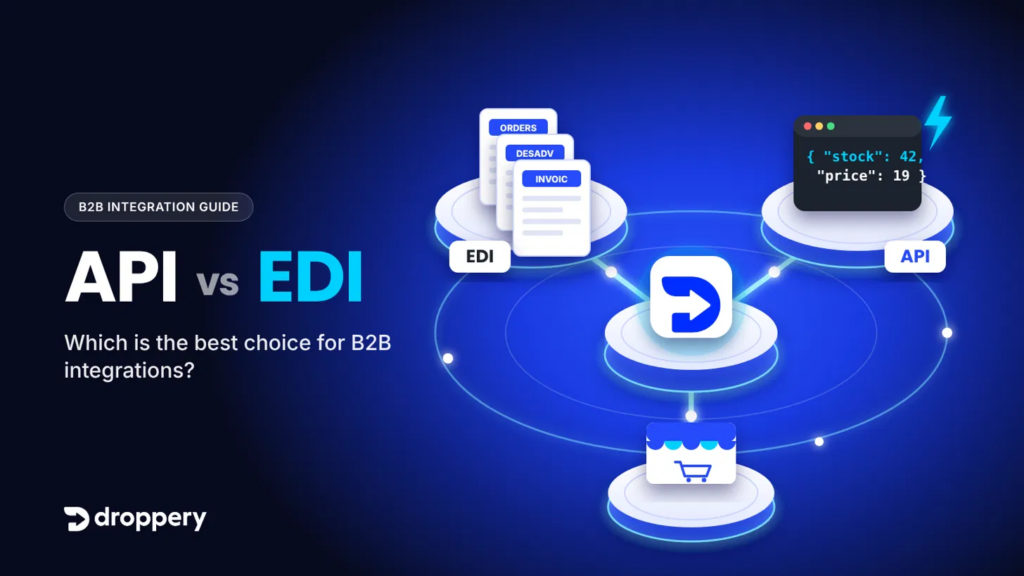
Short answer: EDI is the best choice if you supply large retailers that require standardised messages such as orders and invoices. An API is the best choice if you want to share real-time inventory, prices and product data with webshops and marketplaces. For most growing suppliers and retailers in 2026, a hybrid approach is the smartest option: EDI where it is required, API where it is possible, and one platform that translates both.
Every day, millions of orders, invoices and inventory updates flow between suppliers and retailers. How that data flows determines whether your customer orders a product that has long been sold out, or whether everything is correct down to the last unit. At Droppery, we connect suppliers to retailers in the Netherlands, Belgium, Germany and France every day. The question we hear most often: should we use EDI or an API?
In this blog, we explain the difference clearly, compare the advantages and disadvantages, and give you a practical decision guide.
What is EDI?
EDI (Electronic Data Interchange) is a method for exchanging business documents in a fixed, standardised format between computer systems. Think of purchase orders, shipping notices and invoices. EDI has existed since the 1970s and is still the backbone of the supply chain at large retailers, wholesalers and logistics companies.
The best-known standards are UN/EDIFACT (international and dominant in Europe) and ANSI X12 (mainly in the United States). In the Netherlands, GS1 Nederland plays a major role in standardising EDI messages in retail, food and DIY.
Typical EDI messages include:
- ORDERS – purchase order from retailer to supplier
- DESADV – shipping notice (what is included in the delivery)
- INVOIC – invoice
- PRICAT – price and item catalogue
EDI usually works in batches: messages are collected and sent at fixed times, often via a VAN (Value Added Network) or AS2 connection.
What is an API?
An API (Application Programming Interface) is a modern integration that allows systems to communicate with each other directly and in real time. Instead of sending a file at a fixed time, one system requests data from the other, or sends an update as soon as something changes.
Most modern APIs work via REST and JSON and are described according to the OpenAPI specification. All major e-commerce platforms offer an API, such as the Shopify API and the WooCommerce REST API.
With an API, you can share much more than just orders and invoices: inventory levels by the second, price changes, product images, track-and-trace information and return statuses.
API vs EDI: the key differences
| Feature | EDI | API |
| Speed | Batch (minutes to hours) | Real time (milliseconds) |
| Implementation time | Weeks to months | Days to weeks |
| Costs | High: VAN, mapping, maintenance per partner | Low to medium, highly scalable |
| Standards | Strict (EDIFACT, X12, GS1) | Flexible (REST, JSON, OpenAPI) |
| Flexibility | Fixed message types | Any data flow possible |
| Ideal for | Large retailers, high volumes | Webshops, marketplaces, SaaS |
1. Speed: batch versus real time
EDI is reliable, but slow. If a retailer retrieves inventory at 2:00 p.m. and the product sells out at 2:05 p.m., the webshop continues selling something that no longer exists until the next batch. With an API, that inventory change is passed on immediately. In e-commerce, where customers want delivery within a day, that difference is enormous.
2. Implementation and onboarding
Connecting a new EDI partner often means: aligning message specifications, building mappings, testing in multiple rounds and certifying. With a well-documented API, a developer can sometimes go live within days. For suppliers that want to open new sales channels quickly, that is the difference between seizing an opportunity and missing one.
3. Costs
EDI often involves recurring costs: VAN subscriptions, costs per message and maintenance of mappings per trading partner. APIs usually have lower entry costs, although your own API integration does require development capacity and maintenance when a platform releases a new version.
4. Standardisation and reliability
This is where EDI wins. The strict standards ensure that an invoice means the same thing for every partner. APIs are more flexible, but every API is different. Anyone integrating with ten webshop platforms has to deal with ten different data models.
5. What you can share
EDI is built for transactions. APIs are built for interaction. If you want to share product content, images, live inventory or dynamic prices with retailers, EDI quickly falls short.
Why EDI is not disappearing in 2026: e-invoicing and Peppol
Anyone who thinks EDI is on the way out is not looking at Europe. Due to mandatory e-invoicing, structured data exchange is actually becoming more important:
- Belgium: since 1 January 2026, structured e-invoicing between businesses has been mandatory via the Peppol network. More information can be found at eInvoicing Belgium.
- Germany: companies have had to be able to receive e-invoices since 2025; the obligation to send them will be introduced in phases in 2027 and 2028.
- France: from September 2026, all companies must be able to receive e-invoices; large and medium-sized companies must also send them, with SMEs following in 2027.
- European Union: with the ViDA package (VAT in the Digital Age), e-invoicing in cross-border B2B commerce is gradually becoming the norm.
For suppliers selling in the Benelux, Germany and France, this means: you cannot avoid structured messages. But that does not mean your entire integration strategy has to run on old-fashioned batch processing.
Which choice suits your business?
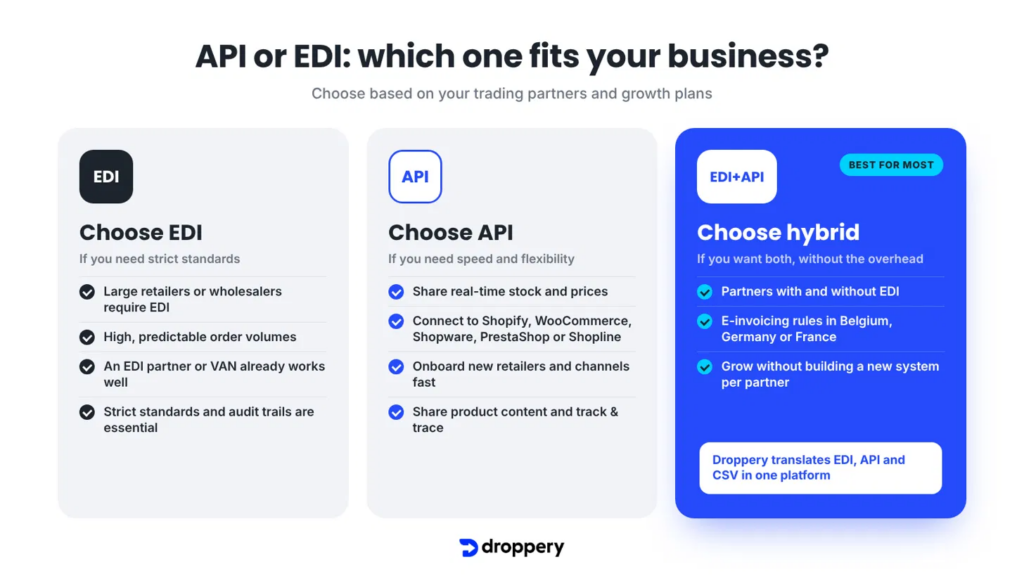
Choose EDI if:
- you supply large retailers or wholesalers that require EDI as a condition;
- you process high, predictable order volumes;
- you already use an EDI partner or VAN that works well;
- strict standards and audit trails are essential to you.
Choose API if:
- you want to share inventory and prices in real time;
- you integrate with webshops on Shopify, WooCommerce, Shopware, PrestaShop or Shopline;
- you want to onboard new retailers or sales channels quickly;
- you want to share more than just orders and invoices, such as product content and track-and-trace.
Choose a hybrid approach if:
- you have trading partners with and without EDI;
- you must comply with e-invoicing obligations in Belgium, Germany or France;
- you want to grow without building a new system for every partner.
The smartest route: one platform that translates everything
In practice, at Droppery we see that almost no company is purely EDI or purely API. A furniture supplier supplies a large retail chain via EDI, dozens of webshops via an API, and sends a CSV feed to a small concept store. Three integration methods, three times the maintenance, three times the chance of errors.
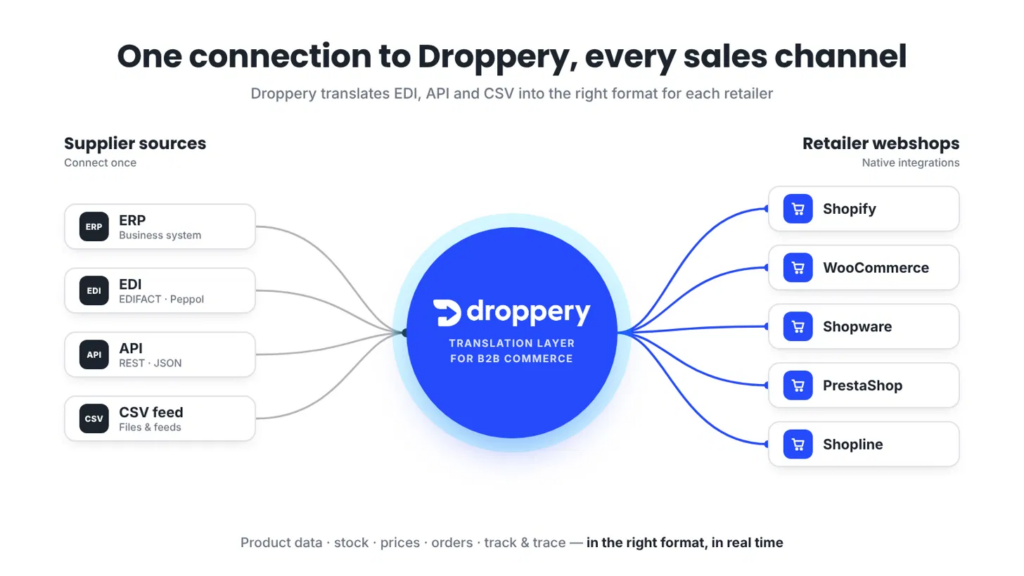
That is why more and more suppliers and retailers choose a B2B commerce platform that acts as a translation layer. Droppery connects suppliers and retailers in the Netherlands, Belgium, Germany and France and integrates directly with Shopify, WooCommerce, PrestaShop, Shopware and Shopline. The supplier connects once, and the platform ensures that product data, inventory, prices and orders reach each retailer in the correct format.
The result:
- No overselling thanks to real-time inventory synchronisation.
- Faster onboarding of new retailers, without new custom development for each partner.
- Less manual work and fewer errors in orders and product data.
- Scalable growth across national borders.
Frequently asked questions about API and EDI
What is the main difference between API and EDI?
EDI exchanges standardised documents in batches, while an API allows systems to communicate with each other in real time and flexibly. EDI excels in standardisation, API in speed and flexibility.
Is EDI outdated?
No. EDI is still the standard among large retailers and is becoming more important due to mandatory e-invoicing in Europe. However, EDI is increasingly being supplemented with APIs for real-time data.
Can an API replace EDI?
Technically, often yes, but in practice many large trading partners require EDI. A hybrid solution in which a platform combines EDI and API is therefore usually the best choice.
How much does an EDI integration cost?
This varies greatly by partner and provider. Expect setup costs for mapping and testing, plus recurring costs for a VAN or EDI service provider and maintenance per trading partner.
How quickly can an API integration be implemented?
With a well-documented API or a ready-made integration via a platform such as Droppery, an integration can go live within a few days.
Which integration do I need for Shopify or WooCommerce?
For webshop platforms such as Shopify and WooCommerce, an API is the logical choice. They work with REST and GraphQL APIs by default, not EDI.
What is Peppol and what does it have to do with EDI?
Peppol is a European network for securely exchanging e-invoices and other business documents. It is a modern form of structured data exchange and has been mandatory in Belgium since 2026.
Conclusion: API vs EDI is not an either-or choice
EDI offers standardisation and is indispensable for large retailers and e-invoicing. APIs offer the speed, flexibility and real-time data that modern e-commerce requires. The winners in B2B commerce do not choose between the two, but make sure both work together seamlessly.
Want to know how you, as a supplier or retailer, can serve all your B2B channels with a single integration? Contact the Droppery team via info@droppery.io or call +31 20 210 1895.