
How do you connect hundreds of suppliers to one e-commerce platform?
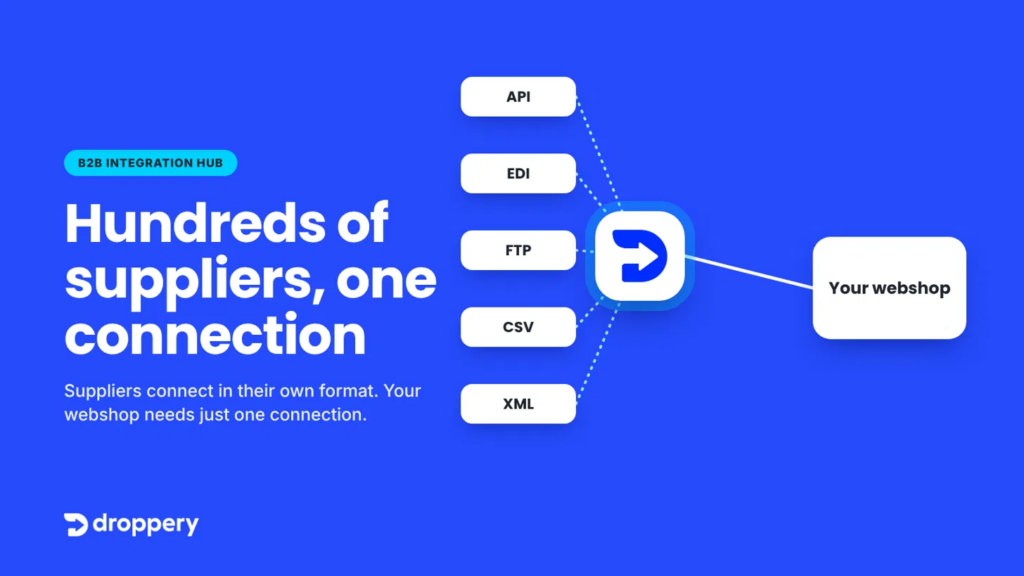
Short answer: You do not connect hundreds of suppliers by building hundreds of separate integrations. You use an integration hub. Each supplier connects to the network once, in its own format (API, EDI, FTP, CSV or XML). Your webshop makes one connection to that hub. Product data, inventory, prices and orders then flow back and forth automatically. This is exactly the model on which Droppery is built.
Most webshops do not have a supplier problem. They have an integration problem.
Retailers want a broader assortment without holding more inventory. Demand for products is still growing. According to the Thuiswinkel Market Monitor, Dutch consumers spent a total of €35.7 billion online in 2025, and online spending on products continued to rise (+2%) (source: NielsenIQ / Thuiswinkel.org).
At the same time, competition is becoming more international. In the Home & Living category, 8% of purchases were made at foreign webshops in 2021. In 2025, that figure was 17%. To win, you therefore need a broader assortment, faster time to market and reliable inventory information.
That is where things go wrong. You can still manage the tenth supplier manually. By the fiftieth, you need a full-time employee copying Excel files. By the hundredth, your developer is repairing a broken feed every week.
Why point-to-point integrations do not scale
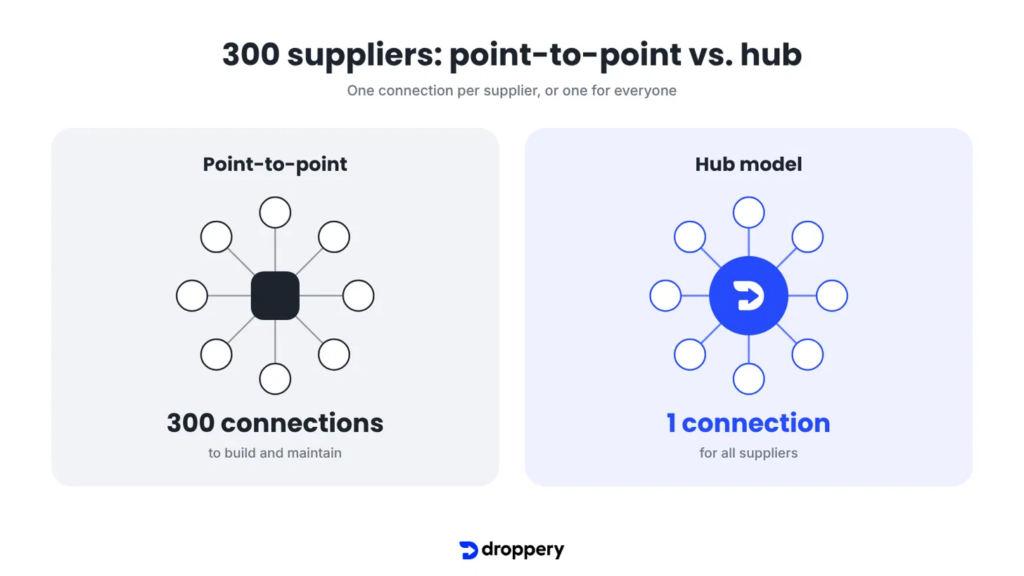
The traditional model works like this: every supplier gets its own connection to your webshop. Supplier A sends a CSV via FTP. Supplier B has a REST API. Supplier C only works with EDI. Supplier D emails an Excel file every Monday.
Every connection has to be built, tested, monitored and maintained. And every time a supplier changes a column name, something breaks.
The calculation:
- Point-to-point: 300 suppliers = 300 connections = 300 places where things can go wrong.
- Hub model: 300 suppliers = 1 connection between your webshop and the network.
The difference is not only in the build cost. It is mainly in maintenance. With point-to-point, every additional supplier creates more work. With a hub, each additional supplier adds virtually no extra work.
What an integration hub actually does
A B2B integration platform such as Droppery sits between suppliers and retailers and takes over four tasks:
- Retrieve data in any format. Suppliers connect using the method they already use: EDI, FTP, REST API or a direct connection to their ERP, such as Exact Online or AFAS.
- Normalize. Colors, sizes, categories, EAN codes and images are converted into one consistent product data model.
- Synchronize. Inventory and prices are updated automatically in your webshop, so you do not sell what is out of stock.
- Route orders. An order containing products from three suppliers is automatically split and sent to the right party.
On the retailer side, you connect your webshop once, for example WooCommerce, Shopware, Magento, Lightspeed, Shopify, PrestaShop or Shopline. View all integrations.
Connect hundreds of suppliers in 5 steps
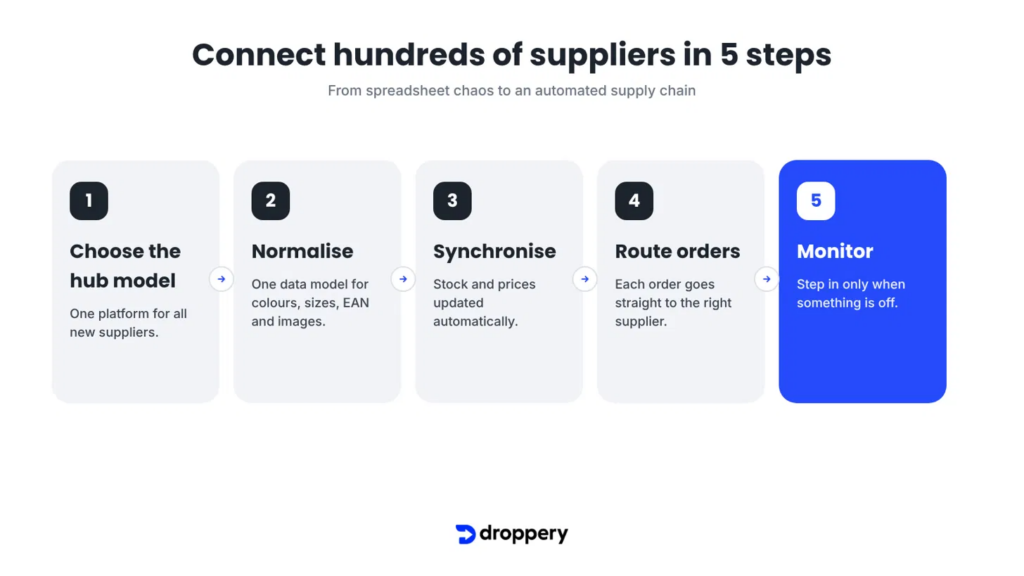
Step 1: Choose the hub model, not another separate connection
Do not build your next supplier integration yourself. First establish that all new suppliers will come in through one platform. This decision determines whether you can handle 50 or 500 suppliers two years from now.
Step 2: Normalize your product data
Agree on one data model: mandatory fields, category structure, image requirements and EAN codes. A good hub automatically translates each supplier’s data into this model. This way, your webshop feels like one brand, even if the products come from 300 different sources.
Step 3: Automate inventory and price synchronization
Overselling is the fastest way to lose reviews. Make sure inventory and purchase prices are updated automatically and regularly, and that out-of-stock products are automatically taken offline.
Step 4: Route orders automatically to the right supplier
With dropshipping or drop delivery, an order must reach the supplier within minutes, not at the end of the day. Track & trace information must automatically flow back into your webshop so your customer stays informed.
Step 5: Monitor exceptions, not everything
With hundreds of suppliers, you cannot check everything manually. Set alerts for deviations: a feed that has not been updated, a price that suddenly drops by 80%, or an order that has not been confirmed. Intervene only when necessary.
What does it deliver? A real-world example
Home and interior brand De Eekhoorn/WOOOD connected its order flow through Droppery. The result: 22% less processing time, 97% fewer errors and orders processed on the same day. That is the difference between manual processes and an automated chain.
Other brands selling through the Droppery network include RV Design, Bazar Bizar, Rivièra Maison, PTMD, J-Line, Actona Group and Boer Staphorst.
For suppliers: one connection, hundreds of retailers
The hub model works in both directions. As a supplier, you also do not want to maintain a separate connection with every webshop. With one connection to Droppery, you reach retailers in the Netherlands, Belgium, Germany and France. The latter is relevant: of every euro Dutch consumers spend online abroad, 26 cents goes to Germany. Cross-border trade is no longer a side issue. Read more about the solution for suppliers and the vendor solution.
Point-to-point vs. hub model at a glance
| Point-to-point | Hub model (Droppery) | |
| Connections with 300 suppliers | 300 | 1 |
| Add a new supplier | Weeks of development time | Connect to the network |
| Data formats | Solve per supplier | Automatically normalized |
| Inventory sync | Per feed, error-prone | Central and automatic |
| Order routing | Manual or custom-built | Automatically split |
| Maintenance | Grows with every supplier | Remains virtually the same |
Frequently asked questions
How do you connect multiple suppliers to one webshop?
Through an integration platform that works as a hub. Each supplier connects once in its own format (API, EDI, FTP, CSV or XML). Your webshop makes one connection to the platform. Products, inventory, prices and orders are then synchronized automatically.
What is the difference between point-to-point and an integration hub?
With point-to-point, you build a separate connection for each supplier, so 300 suppliers means 300 connections. With a hub, everyone connects to one central platform, and your webshop only needs one connection.
Do suppliers need to have an API to connect?
No. Droppery also supports EDI, FTP/SFTP, CSV and XML feeds and direct connections with ERP systems such as Exact Online, AFAS, Twinfield, SnelStart and Unit4. Suppliers can connect using the technology they already use.
Which e-commerce platforms can you connect to Droppery?
Among others Shopify, WooCommerce, Shopware, Magento, PrestaShop, Lightspeed, Shopline, BigCommerce, Ecwid and ePages. View the full overview on the supplier integrations page.
How do you prevent overselling with hundreds of suppliers?
By automatically and regularly synchronizing inventory from the source, and automatically taking out-of-stock products offline. Manual updates are not reliable at this scale.
Is an integration hub only for dropshipping?
No. It also works for retailers that purchase and hold inventory, for marketplaces and for wholesalers that want to distribute their assortment digitally. Dropshipping is one of the applications.
How long does it take to add a new supplier?
With point-to-point, this often takes weeks of development time. If a supplier is already connected to the Droppery network, its assortment can be activated directly in your webshop.
Conclusion: scale your assortment, not your IT team
Connecting hundreds of suppliers to one e-commerce platform is no longer a technical problem, but a choice of the right model. Those who keep building separately for each supplier will sooner or later get stuck on maintenance. Those who choose a hub can add every new supplier without extra complexity.
Want to see how this works for your webshop or supplier network? Request a demo or contact us at info@droppery.io / +31 20 210 1895.
Are you a software partner or agency? Then see how you can become a partner.