Droppery vs Faire: which B2B platform is right for your webshop?
More and more European retailers and brands are comparing platforms before expanding their product range or opening new sales channels. Two names that are often mentioned side by side are Faire and Droppery. Both connect brands with retailers, but the model behind them differs fundamentally — and that difference directly determines your margin, your inventory risk, and how much time you spend processing orders.
In this article, we compare Droppery and Faire on the points that truly matter for European webshops: costs, automation, inventory model, and scalability.
What is Faire?
Faire is an American wholesale marketplace where independent brands make their collections visible to hundreds of thousands of retailers worldwide. Retailers place an opening order with a minimum order value, often with Net 60 payment terms, and receive the inventory in bulk to store and sell themselves.

For brands, Faire operates on a commission basis: customers found through the platform typically cost 15% commission on reorders, with a higher fee (around 25% for brands outside North America, or 15% plus a one-time $10 new-customer fee within North America) on first orders. Customers you bring in yourself through “Faire Direct” are commission-free.
The key characteristic of Faire: retailers purchase inventory upfront, usually without a live connection to their webshop inventory or automatic order forwarding.
What is Droppery?
Droppery is B2B commerce infrastructure that automatically connects suppliers and retailers in the Netherlands, Belgium, Germany, and France. Instead of bulk purchasing, Droppery works with real-time synchronization: inventory, orders, and product data flow automatically between supplier and retailer through direct integrations with Shopify, WooCommerce, PrestaShop, Shopware, and Shopline.
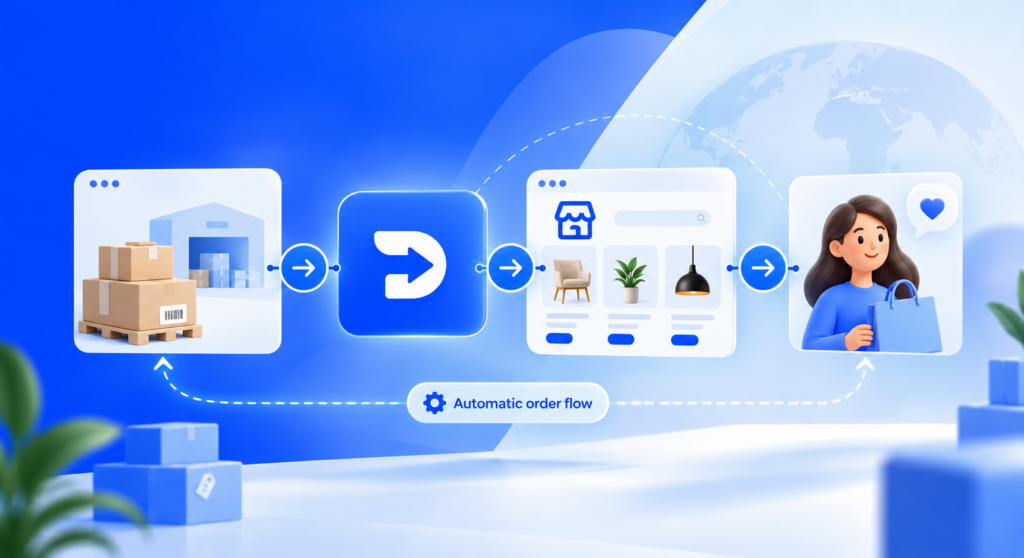
A customer places an order in the webshop → the order automatically goes to the supplier → the supplier ships directly to the end customer. No inventory risk for the retailer, no manual emails, no separate warehouse administration.
Retailers decide for themselves which suppliers they work with, and suppliers always retain control over who is allowed to sell their assortment — through an approval process for each request.
Droppery vs Faire: the main differences
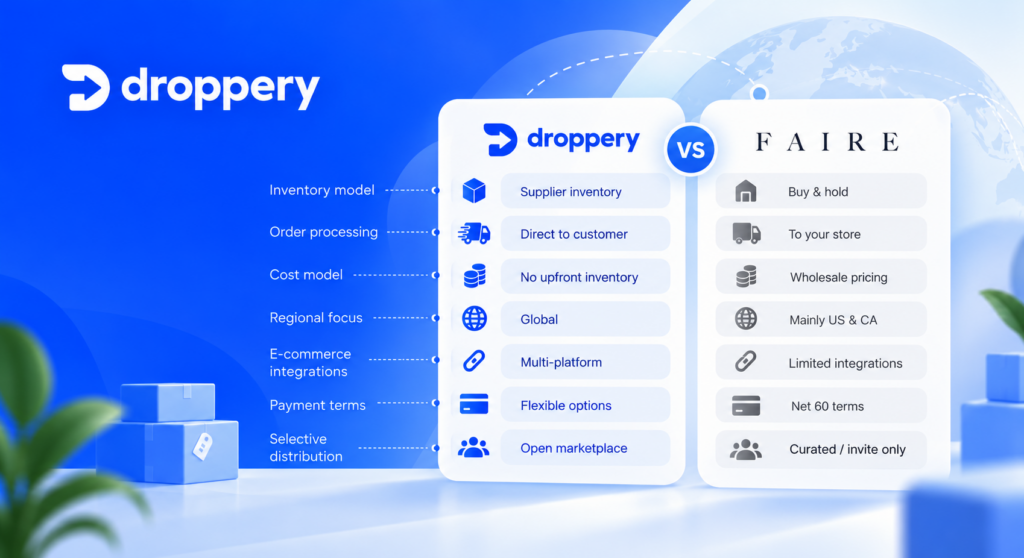
| Droppery | Faire | |
|---|---|---|
| Inventory model | No inventory risk — dropshipping via live sync | Retailer purchases inventory upfront (bulk) |
| Order processing | Fully automated, real-time | Manual management after delivery |
| Cost model | Fixed subscription, no commission per order | Commission per order (15–25%) |
| Regional focus | Netherlands, Belgium, Germany, France | Worldwide, mainly North America |
| E-commerce integrations | Direct integration with Shopify, WooCommerce, PrestaShop, Shopware, Shopline | No live integration with webshop inventory |
| Payment terms | Per collaboration, directly via the platform | Often Net 60 for the retailer |
| Selective distribution | Yes, supplier approves each retailer | Limited, open marketplace model |
Who is Faire suitable for, and who is Droppery suitable for?
Faire is well suited to brands that want to find their first wholesale customers outside their own network, without tech integration, and that are willing to accept inventory risk and commission in exchange for reach.
Droppery is well suited to retailers and brands in the Benelux, Germany, and France that want to expand their assortment without additional inventory risk, that already run a webshop on Shopify, WooCommerce, PrestaShop, Shopware, or Shopline, and that want to automate order processing instead of managing it manually.
Practical example: what automation delivers
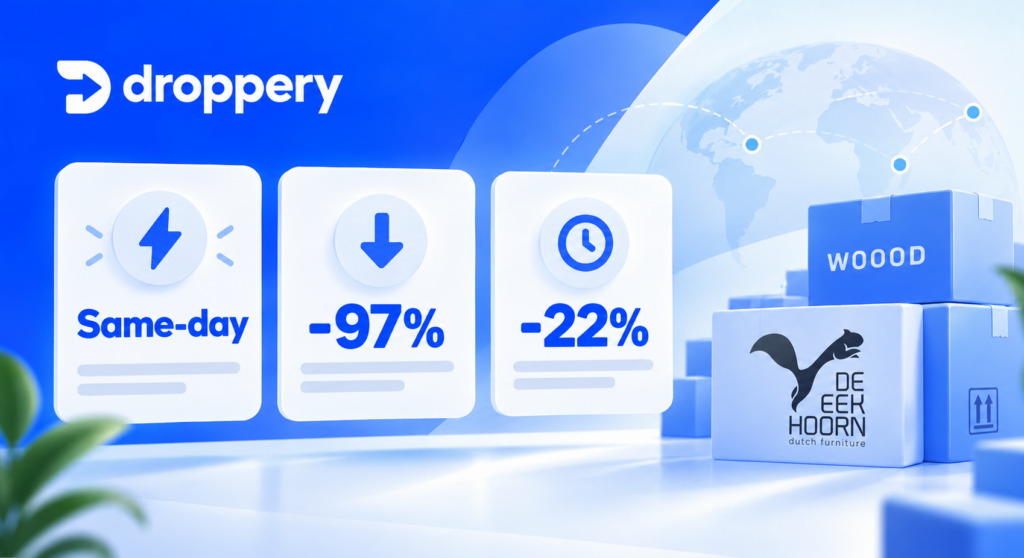
The difference between bulk purchasing and real-time automation is not just theoretical. In the collaboration between WOOOD and De Eekhoorn through Droppery, orders were processed on the same day, with 97% fewer errors and 22% less processing time per order compared with the previous manual process.
That is the type of result you mainly see with platforms that have live integrations — a structurally different model from bulk orders through a marketplace.
Frequently asked questions about Droppery vs Faire
Is Droppery an alternative to Faire in Europe?
Yes. While Faire operates worldwide with bulk inventory and commission per order, Droppery focuses specifically on automated, inventory-free B2B trade between suppliers and retailers in the Netherlands, Belgium, Germany, and France.
What is the biggest difference between Droppery and Faire?
The inventory model. With Faire, the retailer purchases inventory upfront and manages it themselves. With Droppery, inventory is automatically updated through live synchronization, without the retailer having to physically hold stock.
Does a retailer pay commission with Droppery, as with Faire?
No. Droppery uses a fixed platform model instead of commission per order, making the cost structure more predictable than Faire’s 15–25% commission structure.
Does Droppery work with my current webshop system?
Droppery integrates directly with Shopify, WooCommerce, PrestaShop, Shopware, and Shopline, so inventory and orders synchronize automatically without manual work.
As a supplier, can I decide for myself who sells my products?
Yes. With Droppery, the supplier approves each retailer request themselves, unlike Faire’s open marketplace model.
Conclusion
Faire and Droppery both solve a connection problem between brands and retailers, but from a completely different starting point: bulk purchasing with commission versus automated, inventory-free collaboration. For retailers and suppliers in the Benelux, Germany, and France that want to grow without additional inventory risk and without commission per order, Droppery is the infrastructure built for that purpose.
Curious what that means for your webshop or brand? See how Droppery works for retailers or discover the possibilities as a supplier.