
The Gift Industry Is Becoming a Marketplace: What Fleurop, Tony’s Chocolonely and Interhal Teach Us About Selling Gifts in 2026
Short answer: The gift industry is evolving from a market made up of independent shops into a market of networks and platforms. Fleurop has proved for more than a hundred years that a network model works. Tony’s Chocolonely shows that a brand with a story can become the gift itself. Interhal shows that behind every gift is a wholesaler distributing dozens of brands to hundreds of points of sale. Retailers that want to succeed with gifts in 2026 are expanding their assortments without holding their own inventory. They connect their online stores directly to brands and suppliers and ensure their stock levels are updated in real time during peaks such as Saint Nicholas’ Day, Christmas and Valentine’s Day.
Buying a gift feels personal. Yet behind this gesture now lies one of the most automated supply chains in retail. In this article, you will discover what three major names in the gift market are doing, which trends are shaping the industry in 2026 and what this means for your online store or brand.
What Is a Gift Marketplace?
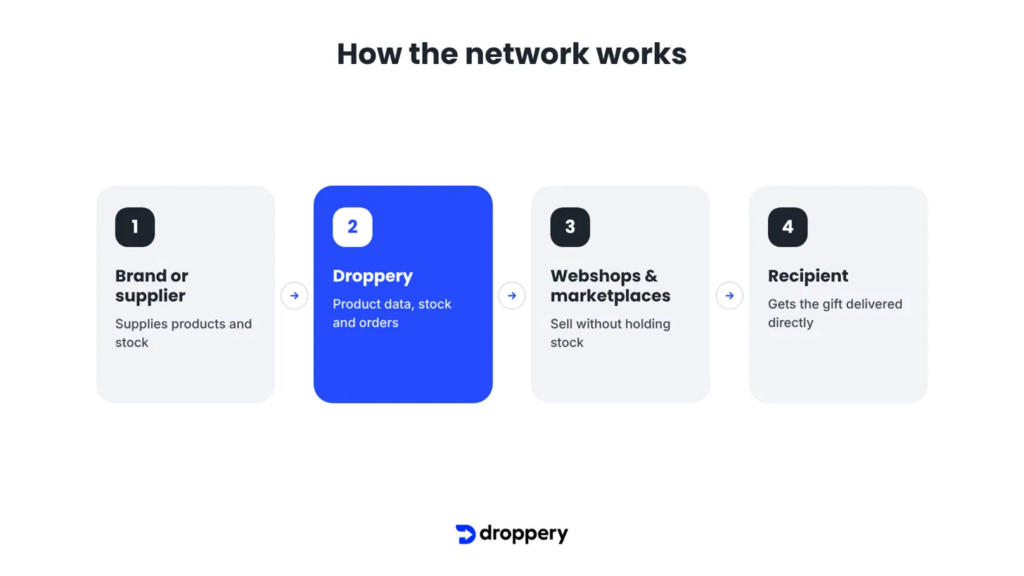
A gift marketplace is a platform that brings together gifts from multiple brands, creators or suppliers and has them delivered directly to the recipient. The platform manages visibility, orders and the customer experience. The product is often delivered by a local partner or directly from the supplier.
The difference compared with a traditional online store: a gift marketplace does not buy all the inventory itself. It connects supply and demand. Its assortment can therefore be much broader than what a single warehouse could hold.
Fleurop: The Original Gift Marketplace (Since 1921)
Long before the word marketplace was used, Fleurop was already operating as one. Fleurop has been active in the Netherlands since 1921 and, in 1995, became the country’s first official online store, when flowers could be ordered and delivered online for the first time. The model is simple and robust: the customer places an order centrally, and a local florist arranges and delivers the bouquet.
This model is under pressure, and that is precisely what makes it interesting. According to figures from the KVK, the number of flower and plant shops in the Netherlands fell from nearly 4,400 in 2019 to 3,880 at the beginning of 2025. Competitors are choosing a different model. Topbloemen.nl now ships more than half of its Dutch orders from its own locations using its own delivery drivers, because relying on local florists could no longer ensure nationwide coverage.
Fleurop has chosen scale. In November 2025, Fleurop acquired fellow company WY Bloemisten. Together, they have around 1,300 affiliated florists, making the combined organisation by far the largest florist organisation in the Netherlands. Fleurop is the market leader in flower delivery, but faces growing competition from new delivery platforms.
There is another lesson. In a presentation about its own e-commerce strategy, Fleurop indicated that demand for flowers given to someone else was barely growing. The response was to add an entirely new product category to fleurop.nl, delivered directly to consumers and aimed at a younger audience.
The lesson: Even the leader in the flower market grows by broadening its assortment, not by selling more of the same thing. The network is the asset; the assortment must evolve with the customer.
Tony’s Chocolonely: The Brand Is the Gift
In the Netherlands, Tony’s Chocolonely is perhaps the best-known “gift that doesn’t need a gift shop”. The chocolate bar is sold in supermarkets, but is also widely given as a gift: for Saint Nicholas’ Day, as a thank-you or in Christmas gift boxes.
The figures show how quickly a purpose-driven brand can grow. Revenue increased by 20% in the last financial year to reach 240 million euros. In the United States, the brand grew by around 50% to 75 million euros, making the US market larger than its Dutch home market.
Tony’s is also building its own network. Through Tony’s Open Chain, other companies can buy fair-trade cocoa according to Tony’s principles. Nearly 27,000 tonnes of fair-trade cocoa were purchased through Open Chain, an increase of 50%. Since 2024, Albert Heijn has committed to purchasing the cocoa for all its own-brand products through Tony’s Open Chain, and in 2021 ALDI became the first discount retailer in the world to join the programme.
The lesson: In the gift industry, it is the story that sells. Consumers choose a gift that says something about the person giving it. Brands with a clear mission, recognisable packaging and an authentic story work better as gifts than anonymous products. For retailers, this means: choose brands that bring a story.
Interhal: The Wholesaler Behind the Gift
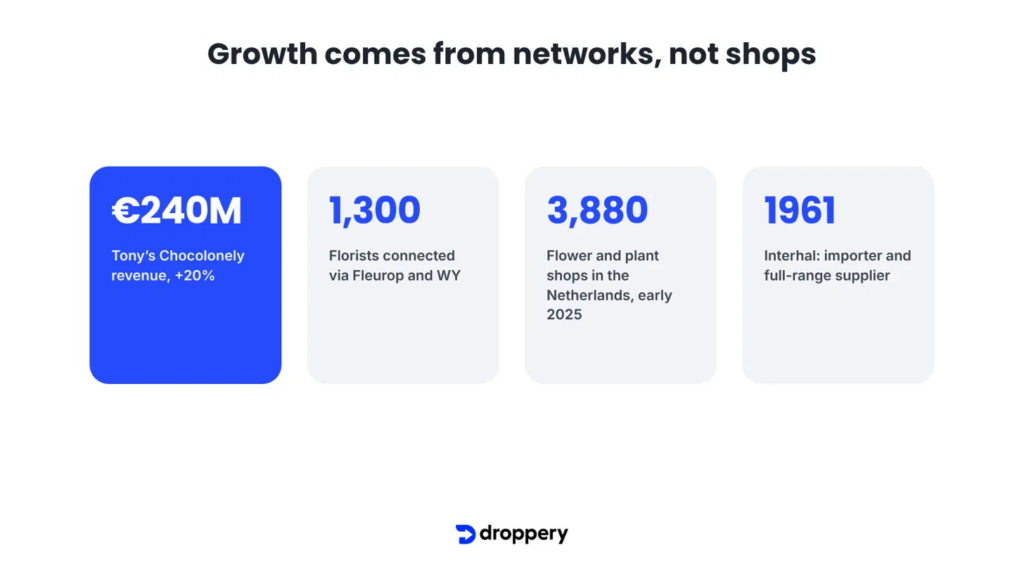
Where Fleurop represents the network and Tony’s represents the brand, Interhal shows what happens behind the scenes. Since 1961, the Breda-based company has been an importer and full-service supplier of branded non-food products: cutlery, glassware, porcelain, kitchen appliances, home accessories, gadgets and items for loyalty campaigns. Gifts & Living is one of its permanent product categories.
The value lies in distribution. Interhal serves the hospitality and healthcare sectors through a network of resellers and reaches consumers through specialist shops, department stores, supermarkets and online retailers. The company has showrooms in Breda, Utrecht, Amsterdam and Brussels and delivers most items directly from its inventory.
This is exactly how the gift market works. The glass, saucepan or designer accessory that someone receives as a gift rarely comes directly from the brand. It passes through an importer or wholesaler that brings together dozens of brands and distributes them to hundreds of points of sale. Loyalty campaigns and points-collection promotions in supermarkets and petrol stations are also, in practice, gifts, and rely on this same wholesale chain.
The lesson: The gift industry depends not only on the shop where the customer buys, but on the chain that gets the product there. Wholesalers and importers with broad brand portfolios are the hidden engine of the gift economy. The better their product data, stock and orders are connected to online stores and marketplaces, the more points of sale they can serve.
6 Trends Shaping the Gift Industry in 2026
1. Networks Are Winning Over Independent Shops
The number of physical gift and flower shops is declining, while platforms are growing. The winners bring together the offerings of many players and organise delivery intelligently, with local partners or directly from the supplier.
2. Broadening the Assortment Is Becoming the New Growth Driver
Even Fleurop is adding new product categories. A florist that also sells chocolate, candles, home accessories or a baby gift increases the average order value. An online gift shop that offers a complete range for every occasion wins the search.
3. Personalisation and Curation
Consumers want a gift that feels thoughtfully chosen. This calls for personalised products or an assortment carefully curated by target audience, such as “gift for a new colleague” or “sustainable newborn gift”.
4. Cross-Border Gifting
Sending gifts to family abroad has become normal, as has shopping across borders. According to the Thuiswinkel Markt Monitor for the first half of 2026, 14% of online purchases are made outside the Netherlands, and for every euro spent abroad, 26 cents go to Germany. Being able to deliver to the Benelux, Germany and France immediately expands the market.
5. Corporate Gifts, Loyalty and B2B Gifting
Companies are increasingly offering a choice rather than a standard Christmas gift box: sustainable brands, local products or a gift chosen directly by the recipient. At the same time, loyalty programmes in which customers save points to obtain branded products are expanding. Both require a broad, up-to-date assortment and reliable delivery, often directly from the wholesaler.
6. Gifts Are Being Discovered Through AI
“What can I give my mother for Mother’s Day with a budget of less than 40 euros?” Consumers are increasingly asking ChatGPT, Gemini or Claude these kinds of questions instead of Google. AI assistants recommend products based on high-quality, complete and structured product data. Online stores with rich product information, clear categories and up-to-date stock are mentioned more often. Discover how an AI Product Hub prepares your product data for SEO and GEO.
What Does This Mean for Online Gift Shops and Retailers?
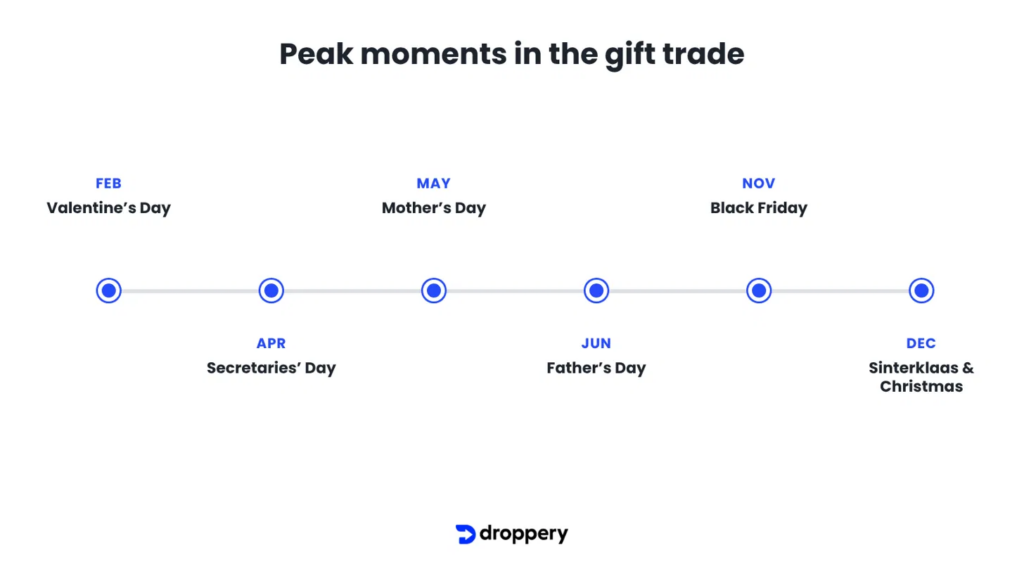
The gift industry operates in peaks. Around Valentine’s Day, Mother’s Day, Saint Nicholas’ Day and Christmas, a large share of annual revenue is generated in just a few weeks. This creates two risks: buying too much inventory that will remain after the holidays, or having too little when it matters.
The Fleurop model provides the solution: sell a broad assortment, but leave delivery to the party that already owns the product. This is exactly how dropshipping through Droppery for retailers works:
- Expand your gift assortment without inventory risk. Add products from European brands and wholesalers to your online store and only sell them once they have been ordered. Discover how this works in expanding your assortment without inventory.
- Real-time stock during peak periods. Nothing is more frustrating than selling a gift that is no longer available on 4 December. Find out why inventory synchronisation often fails and how to fix the problem.
- Fast delivery from Europe. A gift must arrive on time. European suppliers deliver in days rather than weeks. Discover why fast delivery times are the number one growth driver.
- Choose a niche. A specialised gift shop wins more often than a general store. Discover why niche shops outperform general stores.
Droppery connects to Shopify, WooCommerce, PrestaShop and Shopware, among others. See all e-commerce integrations.
And What About Brands, Wholesalers and Importers in the Gift Industry?
Tony’s shows that a strong brand wants to be sold everywhere: in the supermarket, in the concept store, in the online gift shop and in the Christmas gift box. Interhal shows that a wholesaler can only truly scale when it can serve many points of sale simultaneously. For brands and wholesalers in the home, kitchen, lifestyle, kids and gifts sectors, the same logic applies: the more relevant points of sale there are, the more likely their products are to be chosen as gifts.
The challenge is operational. Every new retailer means supplying product data, updating stock and processing orders. With Droppery for suppliers, wholesalers and brands, you automate all of this. You decide for yourself which retailers you work with, and product data, stock and orders flow automatically. Discover how brands expand their retail distribution without additional operational pressure, or how to sell automatically on European marketplaces through a single connection.
A concrete example: read the case study of De Eekhoorn and WOOOD.
Checklist: Prepare Your Gift Offering for 2026
- Define your occasions: Valentine’s Day, Mother’s Day, Father’s Day, Saint Nicholas’ Day, Christmas, births, birthdays and business thank-yous.
- Build a curated collection for each occasion rather than one large assortment.
- Add brands with a story: sustainable, local, design-focused or driven by a clear mission.
- Expand your offering through dropshipping rather than buying additional inventory for peak periods.
- Ensure real-time stock information, especially in November and December.
- Make your product data complete and structured so Google and AI assistants can recommend your gifts.
- Deliver across borders: the Benelux, Germany and France are within reach.
- Start on time: gift-giving peaks throughout the year begin several weeks before the occasion itself.
Frequently Asked Questions About Gift Marketplaces
What is a gift marketplace?
A gift marketplace is an online platform that offers gifts from several brands or suppliers and has them delivered directly to the recipient. The platform manages the sale; delivery is often handled by a local partner or directly by the supplier.
Why is Fleurop an example of a marketplace?
Since 1921, Fleurop has connected customers with a network of local florists. The customer orders centrally, and the florist arranges and delivers. Following the acquisition of WY Bloemisten in 2025, the combined network has around 1,300 florists.
Why does Tony’s Chocolonely work so well as a gift?
Because the brand has a clear story: fair-trade chocolate without exploitation. A gift says something about the person giving it, and a purpose-driven brand reinforces that message. The packaging is also immediately recognisable.
What role do wholesalers such as Interhal play in the gift market?
Wholesalers and importers bring together dozens of brands and distribute them to specialist shops, department stores, supermarkets, online stores and loyalty campaigns. Without them, many physical and online gift shops would not be able to offer a broad assortment of brands.
How can I sell gifts without holding inventory?
Through dropshipping. You sell suppliers’ products in your own online store, and the supplier ships the order directly to your customer. With Droppery, you connect your store to European brands and wholesalers, with automated product data, inventory and order processing.
What are the main peak periods in the gift industry?
Valentine’s Day (February), Secretary’s Day (April), Mother’s Day (May), Father’s Day (June), Black Friday and Saint Nicholas’ Day (November-December), as well as Christmas, including corporate gifts (December). Birthdays, births and thank-you gifts generate demand throughout the year.
How can I make sure my gift shop is found in ChatGPT and Gemini?
Provide complete, unique product descriptions, clear categories by occasion and target audience, up-to-date prices and stock, and content that answers specific questions, such as an FAQ. AI assistants recommend products they can understand well and trust.
Conclusion: Sell the Network, Not Just the Product
Fleurop, Tony’s Chocolonely and Interhal each play a different role in the gift market: the network, the brand and the wholesaler. Their success rests on the same foundation: a strong network, a coherent story and a supply chain capable of delivering during peak periods. The gift industry in 2026 is an industry of marketplaces. Retailers grow by intelligently broadening their assortments; brands and wholesalers grow by being available at more points of sale.
Would you like to expand your gift assortment without inventory risk, or get your brand listed with more retailers? Schedule an online demo or register directly with Droppery.
Sources
- Fleurop – About Fleurop Nederland
- ANP via Welingelichte Kringen – Fleurop acquires WY Bloemisten
- ANP via Nieuws.nl – Sharp decline in the number of florists in the Netherlands
- RetailDetail – Strong sales growth for Tony’s Chocolonely
- Tony’s Open Chain – Who’s in
- Interhal – About us
- Emerce – Twinkle100 and Thuiswinkel Markt Monitor
- Speaker Deck – Fleurop x Sition x Strix