
What is iPaaS and why is it becoming important for B2B e-commerce?
Your webshop runs on Shopify. Your inventory is in an ERP. Your supplier works with its own WMS. And your product data is stored in three Excel files that never quite match. Sound familiar? Then you do not have a software problem, but an integration problem.
That is exactly where iPaaS comes in. In this guide, we explain what iPaaS is, how it works and why, in 2026, it is becoming one of the most important building blocks for anyone doing B2B business through e-commerce.
In short (the key points):
- iPaaS stands for Integration Platform as a Service: a cloud platform that connects all your business systems with each other.
- Instead of dozens of separate integrations, you work with one central integration layer.
- For B2B e-commerce, that means: real-time inventory, automated order processing and consistent product data between suppliers and retailers.
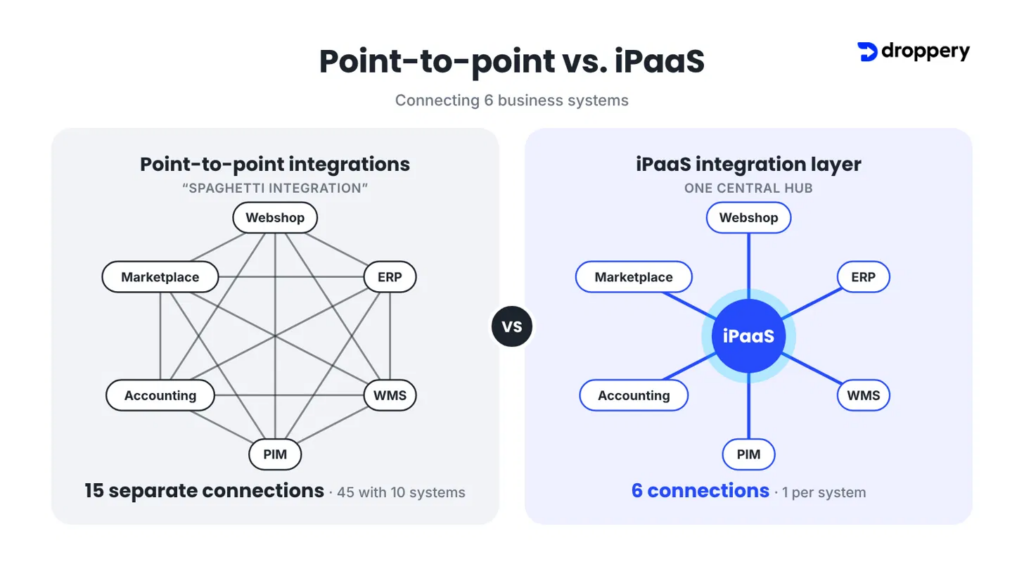
- With six systems, that already makes the difference between 15 separate integrations and 6 connections.
- Droppery works as a specialised integration and distribution layer between European suppliers and retailers.
What is iPaaS? The meaning in one sentence
iPaaS (Integration Platform as a Service) is a cloud platform that allows you to connect applications, systems and data sources so that data flows automatically and in real time between those systems.
Analyst firm Gartner describes it as a vendor-managed cloud service that enables users to build integrations between applications, services and data sources, both inside and outside their own organisation. Source: Gartner, Integration Platform as a Service.
Put simply: iPaaS is the control tower of your e-commerce. Each system talks to the tower, and the tower ensures that the right information arrives in the right place at the right time.
How does iPaaS work?
At its core, an iPaaS platform does four things:
1. Connect. Through ready-made connectors and APIs, the platform connects your webshop, ERP, WMS, PIM, accounting system and marketplaces.
2. Translate. Every system speaks its own language. One calls a product a ‘SKU’, another an ‘item number’. iPaaS maps and translates that data automatically.
3. Automate. An order in your webshop is automatically sent to the supplier, inventory is updated immediately and the track & trace automatically returns to your customer.
4. Monitor. You can see in one place what is going well and what is going wrong, instead of only discovering errors when a customer calls.
Because the platform runs in the cloud and is managed by the provider, you do not need to maintain servers yourself or write integration code. You can find more background on cloud-based integration on Wikipedia.
The spaghetti problem: why separate integrations do not scale
Most B2B companies start with point-to-point integrations. Webshop to ERP. ERP to WMS. WMS to supplier. Every integration works fine, until you grow.
Do the maths. With 6 systems that all need to communicate with each other, you need 15 separate integrations. With 10 systems, that number is already 45. Every integration has to be built, tested, maintained and checked again after every software update.
In practice, we call that spaghetti integration. It works, but nobody dares to touch it anymore.
With iPaaS, each system connects to the central layer once. Six systems, six connections. Adding a new supplier or sales channel becomes a matter of connecting instead of rebuilding.
Why iPaaS is becoming important for B2B e-commerce right now
B2B e-commerce is fundamentally different from B2C. You do not have one webshop and one warehouse, but a network of suppliers, brands, wholesalers and retailers that all use their own systems. Five developments make a smart integration layer indispensable:
1. Customers expect B2C speed in B2B
Business buyers are consumers too. They expect up-to-date inventory, immediate order confirmation and track & trace, just as they do with personal purchases. That is only possible if your systems communicate with each other in real time.
2. Your assortment grows faster than your warehouse
Retailers want to expand their assortment without taking on extra inventory risk. That means selling products from multiple suppliers that ship directly. Without automated inventory synchronisation, you sell products that are no longer in stock.
3. Omnichannel is the standard
Suppliers and brands sell through their own webshops, through retailers, through marketplaces and through physical stores. Product data, prices and inventory must be correct across all those channels. A single source of truth is no longer a luxury.
4. Cross-border trade requires translation
Anyone selling in the Netherlands, Belgium, Germany and France has to deal with multiple languages, currencies, shipping rules and platforms. iPaaS absorbs that complexity in the integration layer instead of in manual work.
5. AI only works with good data
AI tools for forecasting, product copy and customer service are only as good as the data they receive. An integration layer that keeps data consistent and up to date is the foundation for every AI application in e-commerce.
What does iPaaS deliver in concrete terms?
The results are measurable. At De Eekhoorn/WOOOD, one of the suppliers connected through Droppery, automation via the integration layer delivered the following:
- 22% less processing time per order
- 97% fewer errors in order processing
- Orders are processed on the same day
In addition, companies generally see benefits in the following areas:
- Less manual work: no more uploading CSV files or retyping orders.
- Fewer errors: no overselling caused by outdated inventory.
- Faster scaling: new suppliers or sales channels in days instead of months.
- Lower IT costs: no custom integrations that break with every update.
- Better customer experience: correct delivery times, up-to-date inventory and automatic track & trace.
Generic iPaaS or specialised B2B integration layer?
There are large, generic iPaaS platforms that can connect everything to everything. They are powerful, but they often require their own integration team, long implementation projects and substantial licence costs.
For B2B e-commerce, there is a second route: a specialised integration layer that has already been built for the processes between suppliers and retailers. The logic for product data, inventory, orders and shipping is built in by default.
That is exactly what Droppery does. Since 2021, Droppery has been connecting European suppliers, brands and wholesalers from Amsterdam with retailers in the Netherlands, Belgium, Germany and France.
This is how it works:
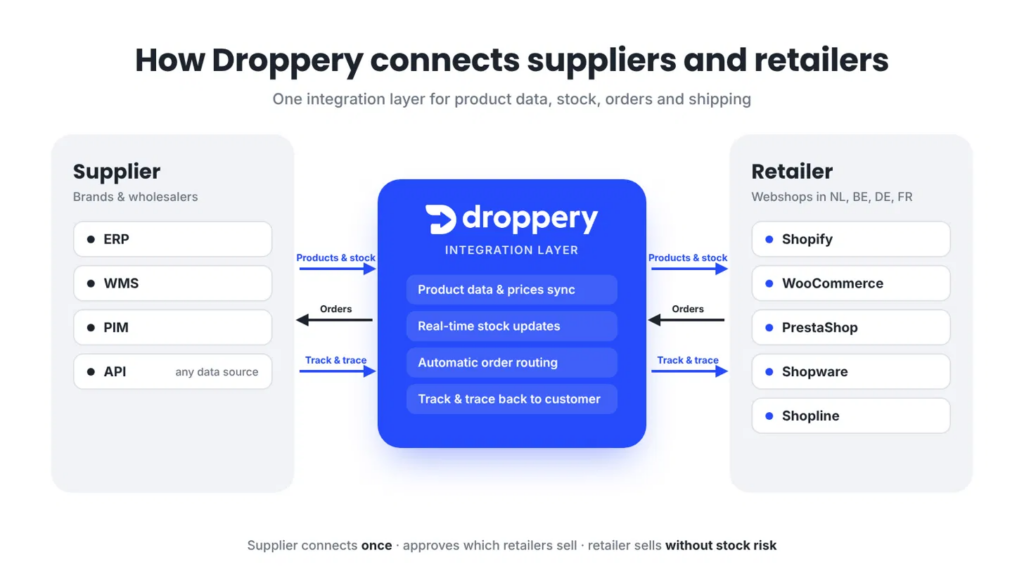
- Suppliers connect their ERP, WMS or PIM to Droppery once. Product data, inventory and prices are automatically shared with approved retailers. The supplier always decides who is allowed to sell its products. More information.
- Retailers connect their webshop through native integrations with Shopify, WooCommerce, PrestaShop, Shopware and Shopline. Products automatically appear in the shop, orders are automatically sent to the supplier and track & trace automatically comes back. More information.
- Developers can connect to virtually any data source, such as an ERP, WMS or webshop, through the Droppery API. Documentation.
The result: suppliers gain an automated distribution channel and retailers expand their assortment without inventory risk, without anyone having to build integrations themselves.
Checklist: is your company ready for iPaaS?
Do you recognise two or more of these signals? Then it is time for an integration layer.
- You work with more than three systems that need to share data with each other.
- Employees process orders or inventory updates manually.
- You have sold products that were no longer in stock.
- Adding a new supplier or sales channel takes weeks.
- Product data differs by channel.
- You want to sell internationally, but your systems are not set up for it.
Frequently asked questions about iPaaS
What does iPaaS mean?
iPaaS stands for Integration Platform as a Service. It is a cloud platform that connects different business systems, such as webshops, ERP, WMS and PIM, so that data is exchanged automatically between those systems.
What is the difference between iPaaS and an API?
An API is a connection point that allows one system to communicate with another. iPaaS is the platform that brings all those APIs together, translates data, automates processes and monitors everything centrally. An API is the plug; iPaaS is the complete power supply.
Is iPaaS only interesting for large companies?
No. SMEs benefit in particular because they do not have their own integration team. With a specialised B2B integration layer such as Droppery, you get enterprise integration without enterprise costs or long implementation projects.
What is the difference between iPaaS and an ESB?
An ESB (Enterprise Service Bus) is traditional integration software that usually runs on the company’s own servers and is managed by an internal IT team. iPaaS runs in the cloud, is managed by the provider and can be scaled faster.
How does iPaaS help with dropshipping?
With dropshipping, a retailer sells products that the supplier ships directly. iPaaS ensures that inventory, prices and product data remain synchronised in real time and that orders and track & trace automatically move back and forth. Without that automation, dropshipping at scale is not manageable.
Which platforms does Droppery work with?
Droppery has integrations with Shopify, WooCommerce, PrestaShop, Shopware and Shopline. Suppliers can also connect their ERP, WMS or PIM through the Droppery API.
How quickly can I get started with a B2B integration layer?
With a generic iPaaS platform, implementation often takes months. With a specialised solution such as Droppery, the integrations have already been built, allowing retailers and suppliers to go live much faster.
Conclusion: integration is the new infrastructure of B2B e-commerce
The winners in B2B e-commerce are not necessarily the companies with the most attractive webshop or the largest warehouse. They are the companies whose systems work together seamlessly: real-time inventory, automated orders, consistent product data and the flexibility to quickly add new partners and channels.
iPaaS makes that possible. For B2B trade between suppliers and retailers, a specialised integration layer is often the fastest and smartest route.
Read also: AI-Powered European Dropshipping: From Product Idea to Reliable Supplier
Ready to connect your suppliers and retailers intelligently?
Discover how Droppery works at Droppery or schedule an introduction via the Contact page.
Droppery B.V. | Vossiusstraat 20-2, 1071 AD Amsterdam | info@droppery.io | +31 20 210 1895