How Much Does an API Integration Cost? And How Do You Calculate the ROI of an Integration Platform?
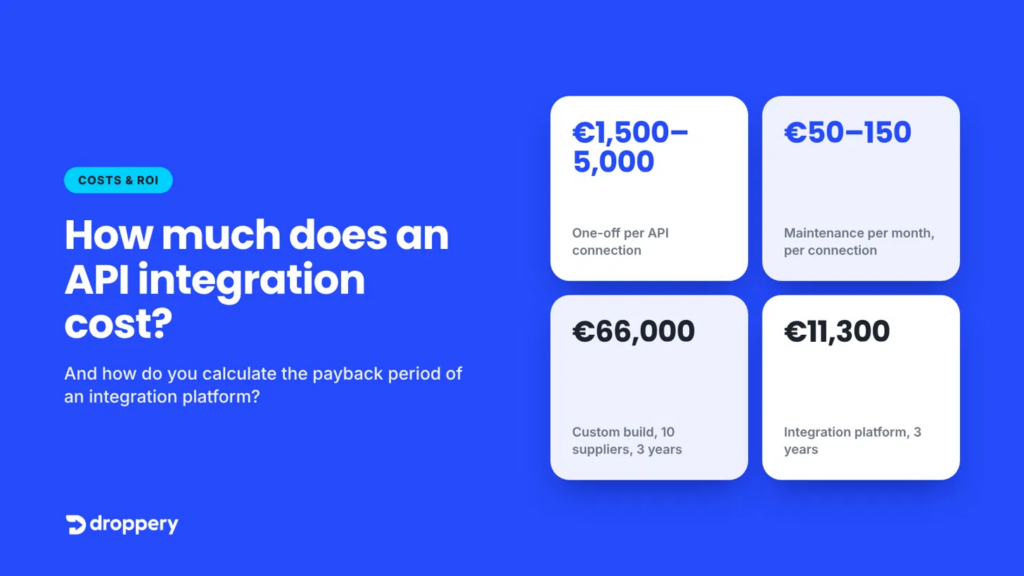
Short answer: For a Dutch online store, a single API integration with a supplier typically costs €1,500 to €5,000, plus €50 to €150 per month in maintenance. That sounds manageable until you have ten suppliers. In our example, custom integrations cost €66,000 over three years, compared with €11,300 using an integration platform. The platform pays for itself in approximately two months. With custom development, it takes almost two years.
At Droppery, we speak every week with online stores and suppliers who ask the same question: “How much does it cost to connect our system?” The truth is that the first integration is rarely the problem. The costs add up with the second, fifth and tenth integrations.
How Much Does an API Integration Cost for an Online Store in 2026?
These are realistic indicative figures for Dutch small and medium-sized businesses (SMEs):
| Type of integration | Indicative one-off cost | Monthly maintenance |
|---|---|---|
| Product feed via plugin (CSV/XML import) | €500–€1,500 | €25–€75 |
| Online store to supplier API integration (freelancer or agency) | €1,500–€5,000 | €50–€150 |
| ERP or accounting integration (Exact, AFAS, SnelStart) | €3,000–€10,000 | €100–€250 |
| Integration platform (iPaaS) | €0–€500 setup | €50–€300 subscription |
These are practical estimates based on conversations with online stores and suppliers in our network.
For larger companies, costs can be considerably higher. Simple integrations start at around $2,000, but complex API projects can quickly exceed $30,000 when both development and maintenance are included (Netguru). An ERP connector with extensive two-way synchronisation can cost €12,000 to €35,000 (Kolonell).
Why Do Prices Vary So Much?
An integration that only imports a product feed is quick to build. But if you also want real-time inventory, orders forwarded automatically and track & trace information sent back to your online store, the integration becomes more complex. Two-way synchronisation, webhooks, rate-limit handling and retry logic make custom integrations more expensive (Scopic). In e-commerce, you almost always need these features. Without real-time inventory updates, you risk selling products that are no longer in stock.
The Hidden Costs That Do Not Appear in the Quote
- Maintenance after every update. Shopify, WooCommerce or your supplier changes something, and the integration stops working. Every fix costs developer hours.
- Costs per partner. Ten suppliers mean ten integrations, ten sets of maintenance tasks and ten potential points of failure.
- Dependence on one developer. If your freelancer stops working with you, nobody else understands the code.
- Errors and overselling. An order that does not go through, or a product that is out of stock, can cost you a return, an unhappy customer or a bad review.
- Growth you put off. Adding another supplier requires yet another integration, so you keep postponing it.
Remember: one integration is affordable. Ten integrations become a second IT department.
Custom Development or an Integration Platform: What Is the Difference?
With custom development, you build a separate connection for every relationship: online store to supplier A, online store to supplier B, and so on. With an integration platform (iPaaS), you connect once and gain access to the entire network. We explain this in more detail in our article “What Is iPaaS and Why Is It Growing So Fast in Ecommerce?”.
With Droppery, an online store connects once through Shopify, WooCommerce, Lightspeed, Adobe Commerce, Shopware, BigCommerce or PrestaShop. That gives the store access to verified European suppliers and brands. Product data, inventory and orders are then synchronised automatically. Adding a new supplier does not require a new integration.
How Do You Calculate the ROI of an Integration Platform?
Use these formulas:
ROI = (Benefits − Costs) ÷ Costs × 100%
Payback period = Total costs ÷ Benefits per month
Step 1: Calculate Your Benefits
- Hours saved: How much time do you currently spend forwarding orders, updating inventory and entering product data?
- Fewer errors: How much does an incorrect order, overselling or a return cost you?
- Additional margin: How much extra margin could a wider assortment generate without having to purchase inventory?
Step 2: Calculate Your Total Costs
Add up the subscription, one-off setup fees and internal staff hours spent on onboarding.
Step 3: The Example Calculation
Scenario: An online store processing 600 orders per month and working with 10 suppliers.
| Annual benefits | Calculation | Amount |
|---|---|---|
| Hours saved | 600 orders × 4 min = 40 hours/month × €30 | €14,400 |
| Fewer errors | 1% of 7,200 orders = 72 errors × €20 | €1,440 |
| Additional margin from a wider assortment | €1,000 per month | €12,000 |
| Total benefits | €27,840 |
| Costs | Custom development (10 integrations) | Integration platform* |
|---|---|---|
| One-off | €30,000 (10 × €3,000) | €500 |
| Per year | €12,000 (10 × €100/month) | €3,600 (€300/month) |
| Total, year 1 | €42,000 | €4,100 |
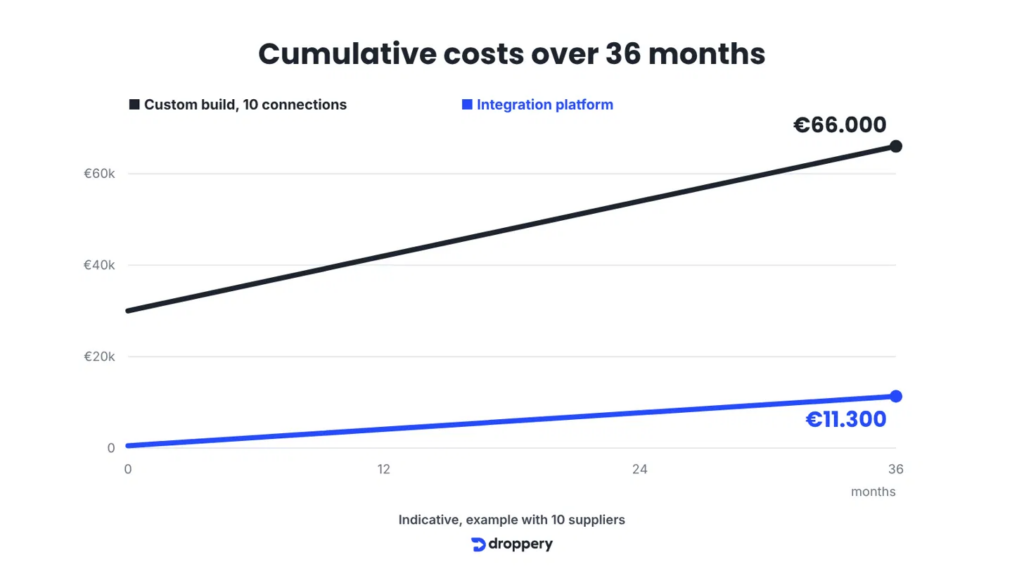
| Total, 3 years | €66,000 | €11,300 |
We have deliberately used the upper end of the usual range (€300 per month). Enter the figures from your own quote for an exact calculation.
Results:
- Custom development, year 1: (€27,840 − €42,000) ÷ €42,000 = −34% ROI.
- Custom development, 3 years: (€83,520 − €66,000) ÷ €66,000 = +27% ROI, with a payback period of approximately 23 months.
- Integration platform, year 1: (€27,840 − €4,100) ÷ €4,100 = +579% ROI.
- Integration platform, 3 years: (€83,520 − €11,300) ÷ €11,300 = +639% ROI, with a payback period of approximately 1.8 months.
Want to allow for a more conservative scenario? Remove the additional margin entirely and count only time savings and fewer errors (€15,840 per year). Even then, the platform achieves +286% ROI in year 1. Custom development falls to −62%.
The benefits are exactly the same in both scenarios. Only the costs differ.
When Is Custom Development the Right Choice?
- You need one unique integration that no platform supports.
- You have a dedicated developer who will maintain the integration for years.
- You only want to connect two internal systems and are not looking for new suppliers or retailers.
If you want to grow by adding new partners, every additional partner requires another custom integration. With a platform, the connection becomes more valuable as more partners join the network.
How Integration with Droppery Works
- Shopify: Install the Droppery app from the Shopify App Store. The app is listed in the original article as starting at $39 per month. You can also follow the Shopify integration instructions.
- WooCommerce: Connect using your API keys with the WooCommerce guide.
- Shopware: Use the Droppery plugin in the Shopware Store.
- ERP and accounting: Droppery integrates with Exact Online, AFAS, Twinfield, SnelStart, Unit4 and Reeleezee, among others. See the store connection guide.
- Custom system: Use the Droppery REST API.
Are you a supplier or brand? With one integration to Droppery, you can reach verified retailers in the Netherlands, Belgium, Germany and France. You no longer need to build a separate integration for every retailer.
Frequently Asked Questions
How Much Does an API Integration Cost for an Online Store?
For SMEs, an API integration between an online store and a supplier usually costs €1,500 to €5,000 upfront, plus €50 to €150 per month in maintenance. A simple product-feed integration via a plugin can start from €500. For major ERP projects, costs can reach €12,000 or more.
What Are the Maintenance Costs of an API Integration?
Budget €50 to €150 per month per integration. This covers platform updates, changes to partners’ APIs and fixing errors.
How Do You Calculate the ROI of an Integration Platform?
ROI = (Benefits − Costs) ÷ Costs × 100%. Benefits include hours saved, fewer errors and additional margin. Costs include the subscription, setup and internal staff hours. Divide the costs by the monthly benefits to calculate the payback period.
Which Is Cheaper: Custom Development or an Integration Platform?
With one or two integrations, custom development can be cheaper. Once you work with several partners, an integration platform is almost always more cost-effective because custom development costs rise with every additional integration. In our example with 10 suppliers, custom development costs €66,000 over three years, compared with €11,300 for a platform.
How Quickly Does an Integration Platform Pay for Itself?
In our example (600 orders per month), approximately two months. Even without additional margin, the platform pays for itself within the first year.
Which Systems Does Droppery Integrate With?
Droppery integrates with Shopify, WooCommerce, Lightspeed, Adobe Commerce, Shopware, BigCommerce and PrestaShop, as well as ERP and accounting systems such as Exact Online, AFAS, Twinfield, SnelStart and Unit4. A REST API is available for other systems.
How Long Does It Take to Connect to Droppery?
With the Shopify app or WooCommerce API keys, you can connect in just a few minutes. You can then start importing products from suppliers immediately.
Conclusion
For most online stores, one API integration is quite affordable. The problem starts when you want to grow: every new supplier requires another integration and more maintenance. An integration platform replaces those accumulating costs with one fixed monthly fee. Enter your own figures into the formula above, and within ten minutes you can see which option makes the most sense for your business.
Want us to calculate your own ROI? Contact the Droppery team at info@droppery.io or +31 20 210 1895. Or create an account directly.
Sources: Netguru – The Real Cost of API Integration · Scopic – API Integration Cost Guide (2026) · Kolonell – Custom API & ERP Integration Cost 2026 · Droppery on the Shopify App Store