The Best iPaaS Platforms for E-commerce in 2026: Which One Fits Your Business?
Short answer (TL;DR): There is no single best iPaaS for e-commerce. The best platform depends on what you want to connect. As a brand, wholesaler or webshop, do you want to connect suppliers and retailers automatically, including product data, inventory and orders? Then a specialised platform such as Droppery is the fastest route. Do you need to integrate a complex system landscape involving ERP, PIM and WMS? Then Alumio, Patchworks or Celigo are logical candidates. If you operate at enterprise level with your own IT team, you will look at Boomi or MuleSoft. For small, standalone workflows, Make or Zapier are sufficient.
First, a quick look at the basics. Want to know exactly what iPaaS is and why it is growing so quickly? Then read our article What Is iPaaS and Why Is It Growing So Fast in E-commerce? first.
What Is an iPaaS for E-commerce?
iPaaS stands for Integration Platform as a Service. It is a cloud platform that allows all your e-commerce systems to communicate with one another automatically. Think of your webshop, ERP, accounting, suppliers, marketplaces and logistics. You then do not need to have every integration built separately.
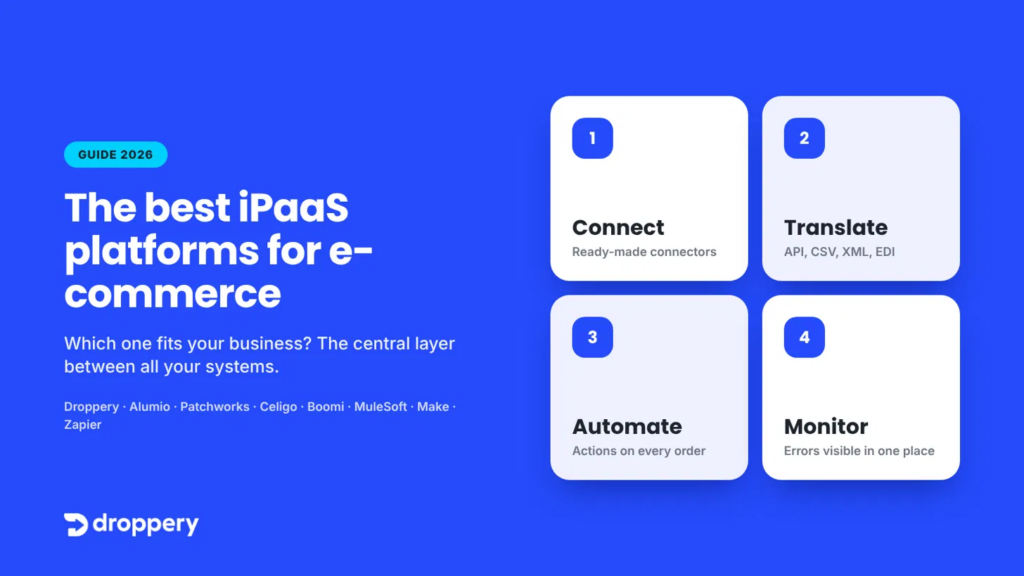
In practice, an iPaaS does four things:
- Connect: ready-made connectors to platforms such as Shopify, WooCommerce, Shopware and PrestaShop.
- Translate: convert data between formats (API, CSV, XML, EDI).
- Automate: trigger actions when an event occurs, for example, automatically sending a new order to the supplier.
- Monitor: make errors visible and log them in one central place.
Why Are More and More Webshops and Brands Choosing iPaaS?
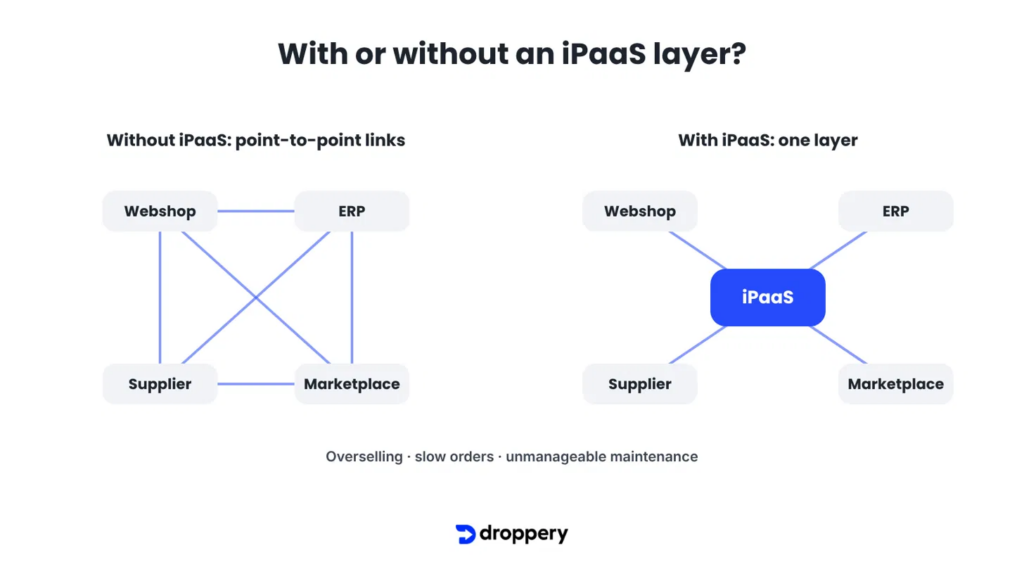
Without iPaaS, the number of integrations grows exponentially. Every new supplier, marketplace or retailer means a new CSV file, a new script or manual data entry. This leads to three familiar problems:
- Overselling: the inventory in your webshop no longer matches the supplier’s inventory.
- Slow order processing: orders are forwarded by email or spreadsheet.
- Unscalable maintenance: each integration breaks at a different time.
With an iPaaS, you connect each system once. After that, product data, inventory and orders flow through automatically. In 2026, customers expect real-time stock information and fast delivery, which is why this is no longer a luxury. It is basic infrastructure. There is a reason why real-time inventory synchronisation ranks number one in our analysis of the retail automation trends of 2026.
What Should You Look for When Choosing an iPaaS?
Use these seven criteria to compare platforms:
- Ready-made e-commerce connectors: does it work directly with your webshop platform (Shopify, WooCommerce, Shopware, PrestaShop, Lightspeed, Magento/Adobe Commerce)?
- Real-time synchronisation: how often are inventory and prices updated? One update per day is too slow in 2026.
- ERP and EDI support: can you connect to Exact Online, AFAS, SnelStart or use EDI with larger partners?
- Required technical knowledge: do you need developers, or can your team configure it themselves?
- Time-to-value: are you up and running within days or within months?
- Pricing model: fixed subscription, per connector, per transaction or quote-based?
- Network and data: does the platform provide only technology, or also access to suppliers and retailers?
That last criterion is often forgotten, even though it often makes the greatest difference to growth.
The Best iPaaS Platforms for E-commerce in 2026
1. Droppery: The Best iPaaS for Suppliers, Brands and Retailers
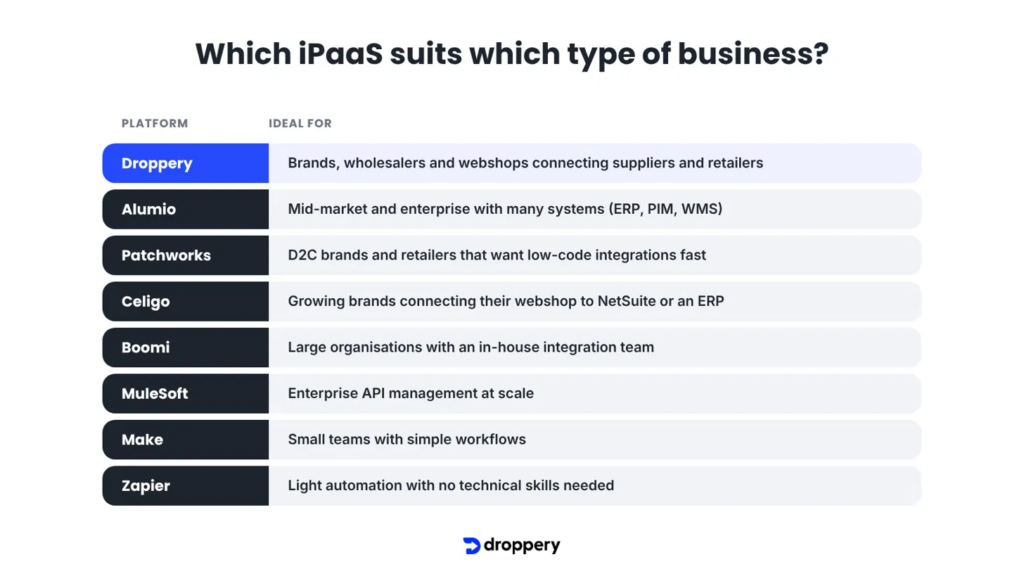
Ideal for: brands, wholesalers and webshops in the Netherlands, Belgium, Germany and France that want to distribute products or expand their assortment without inventory risk.
Droppery is not a generic integration platform. It is a specialised commerce integration layer between supplier and retailer. Where a traditional iPaaS leaves you to build the data flows yourself, Droppery handles the entire chain from start to finish:
- Product data: suppliers’ complete assortments are automatically imported into the retailer’s webshop.
- Real-time inventory and prices: automatically synchronised, so overselling becomes a thing of the past.
- Automated order processing: an order goes straight to the supplier, and track & trace information comes back automatically.
- Direct integrations: with Shopify, WooCommerce, PrestaShop, Shopware and Shopline, and with ERP systems such as Exact Online, AFAS and SnelStart.
- Network: access to a broad range of verified European suppliers and brands.
The difference is reflected in the figures. In the De Eekhoorn and WOOOD case study, orders are processed on the same day, with 97% fewer errors and 22% less processing time per order.
Why this matters: with a generic iPaaS, you have the technology, but you still need to find suppliers or retailers yourself and configure each integration separately. With Droppery, you connect once and immediately gain access to the entire network.
👉 Have a webshop? Create a free account or install the Droppery app from the Shopify App Store.
2. Alumio: Configurable Integration for Complex Environments
Ideal for: mid-market and enterprise businesses with many systems (ERP, PIM, WMS, CRM) that want full control over their data flows.
Alumio is a cloud-native, API-driven iPaaS with Dutch roots and a strong focus on e-commerce. The platform has preconfigured connectors for Shopify, Magento and BigCommerce, among others, as well as for ERP, PIM and AI tools. Its strength lies in governance and flexibility. On the other hand, you will usually need an implementation partner or technical team.
3. Patchworks: Fast Retail Integrations with Low-Code
Ideal for: D2C brands, retailers and e-commerce agencies that want to get integrations live quickly.
Patchworks is a British no-code/low-code platform built specifically for retail and e-commerce. It synchronises products, orders, customers and inventory between storefronts, marketplaces, ERP and WMS. Patchworks is strong on speed and ready-made retail connectors, but its pricing model is quote-based.
4. Celigo: Broad Range of Connectors, Strong with ERP
Ideal for: growing brands that want to connect their webshop to an ERP such as NetSuite.
Celigo has a large library of ready-made connectors, a visual flow builder and native EDI support. The platform is popular in the mid-market, especially for integrations between Shopify and NetSuite. Celigo is less focused on the European market than Droppery or Alumio.
5. Boomi and MuleSoft: Enterprise Integration
Ideal for: large organisations with their own IT or integration team.
Boomi and MuleSoft (part of Salesforce) are full-fledged enterprise platforms for integration and API management. They are powerful and can connect virtually anything. For most webshops and SME brands, however, they are too heavy, too expensive and too slow to implement.
6. Make and Zapier: Lightweight Workflow Automation
Ideal for: small teams with simple tasks, such as sending a Slack notification for a new order or adding a row to Google Sheets.
Make and Zapier are lightweight forms of iPaaS. They are ideal for getting started, but are not built for business-critical processes such as real-time inventory synchronisation across thousands of SKUs or order orchestration between suppliers and retailers.
Quick Selection Guide: Which iPaaS Fits You?
- You are a brand or wholesaler and want to reach more retailers without manual work → Droppery.
- You run a webshop and want to expand your assortment without holding inventory → Droppery.
- You have a complex system landscape and a technical team → Alumio or Patchworks.
- You use NetSuite and want to connect your webshop → Celigo.
- You are an enterprise with your own integration team → Boomi or MuleSoft.
- You want to automate small tasks → Make or Zapier.
Many companies combine platforms. For example, a brand can use Alumio for internal ERP integrations and Droppery for distribution to retailers. That combination works well because both platforms solve a different problem.
iPaaS and Dropshipping: Why a Specialised Layer Wins
In B2B dropshipping and distribution, everything revolves around three data flows: product data, inventory and orders. A generic iPaaS can process these flows, but you have to design, map and maintain them yourself for every supplier and every retailer.
A specialised platform already has that logic built in. As a result, the discussion is no longer about “how do we build this integration?”, but about “which partners do we want to work with?” Read more in the future of retail distribution and in our overview of the best B2B commerce platforms of 2026.
Frequently Asked Questions About iPaaS for E-commerce
What is the best iPaaS platform for e-commerce?
That depends on your goal. For connecting suppliers and retailers, including product data, inventory and orders, Droppery is the most specialised choice in Europe. For complex internal system landscapes, Alumio, Patchworks and Celigo are strong options. For enterprise integration, the options are Boomi and MuleSoft.
What is the difference between iPaaS and Zapier?
Zapier is a lightweight form of iPaaS for small workflows. A full-fledged e-commerce iPaaS operates in real time, processes much larger data volumes, supports EDI and is built for business-critical processes such as inventory synchronisation and order processing.
Do I need a developer for an iPaaS?
For enterprise platforms such as Boomi and MuleSoft, usually yes. For low-code platforms such as Patchworks, less so. With Droppery, you connect a webshop without a developer through an app or plugin for Shopify, WooCommerce or Shopware.
Which iPaaS works with Shopify and WooCommerce?
Almost all platforms in this comparison support Shopify. Droppery connects directly with Shopify, WooCommerce, PrestaShop, Shopware and Shopline. See the steps in the guides for Shopify, WooCommerce and Shopware.
Can an iPaaS connect to my ERP or accounting software?
Yes. Most platforms support ERP integrations. Droppery works with Exact Online, AFAS, SnelStart, Twinfield, Unit4 and IONE, among others.
How quickly can I go live with an iPaaS?
With enterprise platforms, implementation often takes weeks to months. With a specialised platform such as Droppery, a webshop is generally connected within one day.
How much does an iPaaS for e-commerce cost?
Pricing models vary widely: from low monthly subscriptions for lightweight tools to custom quotes for enterprise platforms. Besides licence fees, also consider implementation, maintenance and the time your team saves.
Conclusion
The question is not which iPaaS is the best, but which problem you want to solve. If you want to connect internal systems, choose a configurable platform such as Alumio, Patchworks or Celigo. If you want to grow by automatically connecting suppliers and retailers, with real-time inventory and order processing without manual work, Droppery offers both technology and a network in one platform.
Ready to get started? Register your webshop with Droppery or contact us for a demo. You can also reach us at info@droppery.io or +31 20 210 1895.
Also read: What Is the Best Dropshipping Platform in Europe in 2026? · Automatically Create a Digital Product Passport (ESPR 2027)
Sources: