How Brands Can Build a Digital Distribution Network (and Why It Is Your Biggest Growth Opportunity in 2026)
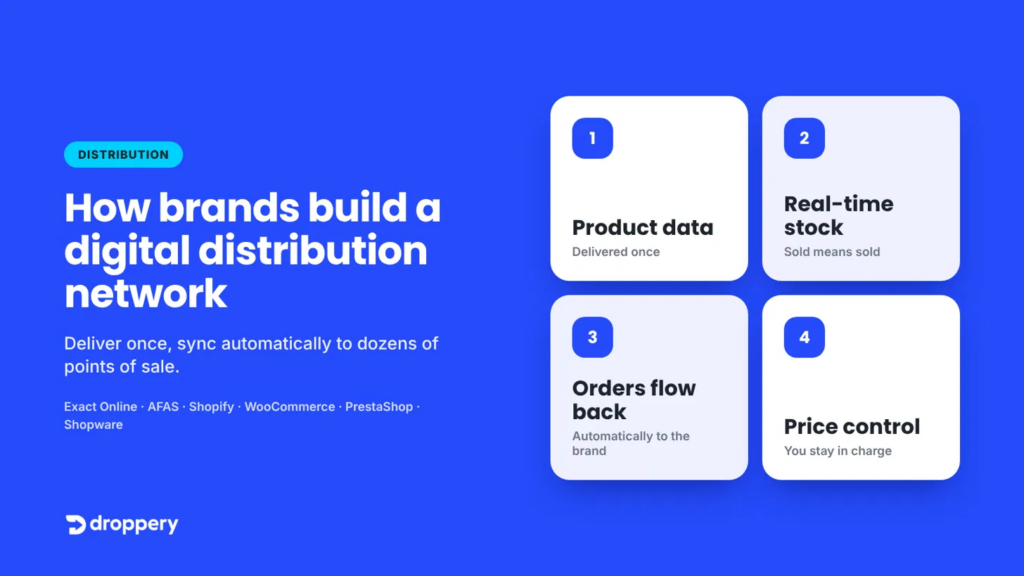
Short answer: A brand builds a digital distribution network by providing its product data, inventory and prices centrally, just once, and automatically synchronising them with dozens of online stores and retailers. Orders then flow back to the brand automatically. This allows the number of sales outlets to grow without additional inventory, extra staff or separate Excel spreadsheets.
The Problem: Most Brands Sell Through Too Few Channels
Many brands in home & living, lifestyle and consumer goods still operate through a traditional dealer model. They have a handful of established retailers, an account manager who emails price lists, and orders arriving by email or telephone.
That model works until you want to grow. Each new retailer then brings additional manual work: supplying product data, communicating stock levels, re-entering orders and sending invoices. As a result, the number of sales outlets remains small, even though demand is online.
The market, meanwhile, has already moved online. Dutch consumers spent €35.7 billion online in 2025 (Thuiswinkel Market Monitor / NIQ). The number of purchases from foreign online stores rose by 9% in 2025 to 44.8 million. If your brand is not present in the online stores where consumers shop, those consumers will buy something else, often from a foreign platform.
Business buyers have changed too. According to McKinsey’s B2B Pulse research, B2B buyers divide their preferences roughly equally between in-person contact, remote interactions and digital self-service. Most buyers also use ten or more channels to interact with suppliers. A brand that sells only through an account manager therefore misses most of the buying journey.
What Is a Digital Distribution Network?
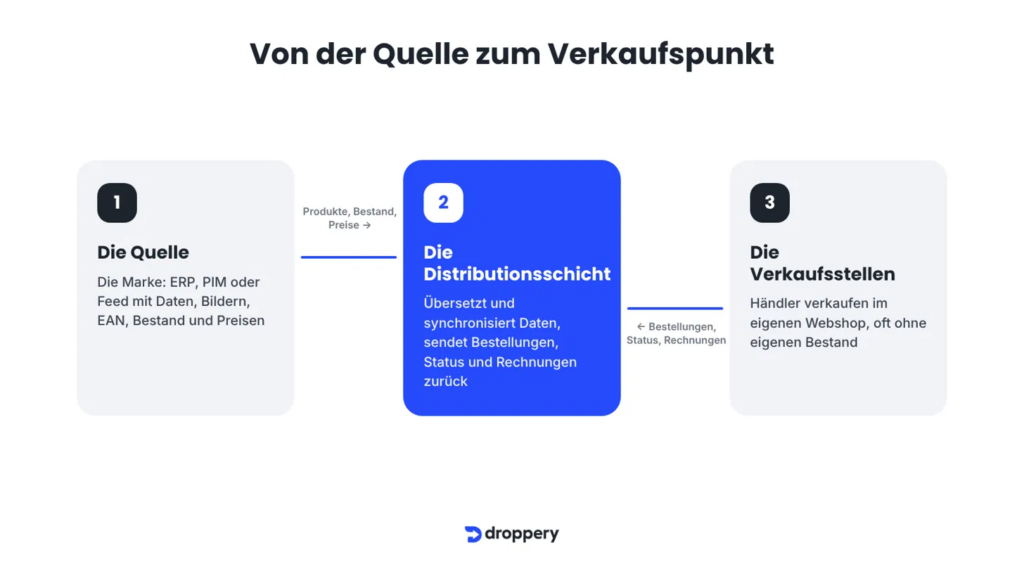
A digital distribution network is an automated connection between one brand or supplier and a large number of sales outlets. These include online stores, retailers, marketplaces and your own direct-to-consumer (D2C) channel. The network has three layers:
- The source (the brand): your ERP, PIM or product feed containing product information, images, EAN codes, stock levels and prices.
- The distribution layer: a platform that automatically converts and synchronises that data with every connected sales outlet. The platform also sends orders, statuses and invoices back.
- The sales outlets: retailers that sell your products through their own online stores, often without holding stock themselves.
The difference from a traditional wholesale structure is this: you no longer manage every relationship separately. You provide the data once, and the network takes care of the rest.
Why Brands Are Making the Switch Now: 5 Benefits
- More sales outlets without extra staff. Connecting a new retailer takes minutes rather than weeks. With Droppery, an existing or new reseller can be connected in just a few minutes.
- No inventory risk for your retailers. Retailers can display your entire assortment without buying it upfront. That means more of your products appear online, including the long-tail items currently sitting in your warehouse.
- Real-time inventory, so fewer cancellations. Once an item has sold, it is sold. With automatic inventory synchronisation, you only sell what is actually in stock.
- Control over prices and partners. You decide which retailers may sell your products and which pricing tier applies to them. Your brand experience and margins therefore remain under your control.
- International growth without a local office. Retailers in Belgium, Germany and France sell your products through their own online stores in their own language. You do not need to set up a local team.
How to Build a Digital Distribution Network in 5 Steps
Step 1: Get Your Product Data in Order
Your network is only as strong as your data. Make sure your product information is complete: titles, descriptions, dimensions, materials, at least four good product photos, EAN codes and up-to-date inventory. Incomplete data is the number one reason retailers do not put products live.
Step 2: Connect Your Systems Once
Connect your ERP, PIM or product feed to a distribution platform. Droppery integrates with commonly used systems such as Exact Online, AFAS, SnelStart and Twinfield. Product data, inventory and prices then synchronise automatically. Learn more about Droppery for brands and suppliers.
Step 3: Choose Your Retailers Carefully
More sales outlets are not automatically better. Select retailers that fit your positioning, price point and target audience. Start with 10 to 20 strong partners in your home market, then expand into other countries.
Step 4: Automate Orders, Status Updates and Invoices
As soon as a consumer places an order with a retailer, that order should reach you automatically, including track & trace information and invoicing. Retailers can easily connect their online stores via Shopify, WooCommerce or PrestaShop. To see what this looks like in practice, read Fully Automated Dropshipping: What Does It Really Look Like?.
Step 5: Measure, Learn and Scale
For each retailer, track sell-through, return rates and average order value. Invest in the partners that perform well, help the others with better content, and then open up new countries.
Traditional Distribution vs. a Digital Distribution Network
| Traditional dealer model | Digital distribution network | |
|---|---|---|
| Connecting a new retailer | Weeks (price lists, data, agreements) | Minutes to days |
| Product data | Supplied separately to each retailer | Supplied once, then synchronised automatically |
| Inventory | Shared manually, often outdated | Real time |
| Orders | Email, telephone, manual re-entry | Forwarded automatically |
| Retailer’s inventory risk | High (upfront purchasing) | Low (selling without stock) |
| International expansion | Requires a local agent or importer | Directly through retailers in NL, BE, DE and FR |
| Scalability | Linear: more customers = more staff | Exponential: more customers = the same team |
Common Mistakes (and How to Avoid Them)
- Starting with poor product data. Retailers will not put products live with only one photo and no dimensions. Invest in content first.
- Letting everyone in. A network with the wrong retailers damages your brand. Screen your partners.
- Having no pricing policy. Define the recommended retail price and retailers’ margins in advance. This helps prevent price wars.
- Treating it as an IT project. Distribution is a commercial strategy. Put someone in charge of actively onboarding, engaging and supporting retailers.
How Droppery Helps Brands Build Their Network
Droppery is an Amsterdam-based B2B commerce platform that has connected brands, suppliers and retailers in the Netherlands, Belgium, Germany and France since 2021. Brands provide their assortment once. Droppery synchronises product data, inventory and prices with connected online stores on platforms including Shopify, WooCommerce, PrestaShop and Shopware, and automatically sends orders back.
Home & living brands already working with Droppery include De Eekhoorn/WOOOD, Bazar Bizar, Rivièra Maison, PTMD, J-Line and Actona Group. They use the platform to expand their sales network without additional operational pressure.
Want to know how automation is shaping the future of e-commerce? Read The End of Manual Retail Operations.
Ready to build your distribution network? Explore the packages for suppliers and brands or contact us at info@droppery.io or +31 20 210 1895.
Frequently Asked Questions
What is a digital distribution network for brands?
A digital distribution network is an automated connection between a brand and multiple sales outlets, such as online stores, retailers and marketplaces. Product data, inventory and prices are managed centrally and synchronised automatically. Orders flow back to the brand automatically.
How can I find new retailers for my products as a brand?
Through a B2B distribution platform such as Droppery, you can connect with retailers already active in your category. Retailers can import your assortment into their online stores, and you decide who is allowed to sell your products.
Do retailers have to purchase inventory?
No, they do not have to. Retailers can sell your products through dropshipping: the consumer orders from the retailer, and you ship directly to the consumer. This can also be combined with conventional wholesale purchasing.
How long does it take to set up a digital distribution network?
The technical integration is usually ready within a few days. Building a strong retailer network is an ongoing process. Most brands start with 10 to 20 partners and then expand.
Which systems can I connect?
Droppery integrates with ERP systems such as Exact Online, AFAS, SnelStart and Twinfield. Retailers connect through platforms including Shopify, WooCommerce, PrestaShop and Shopware.
Do I keep control of my prices and brand?
Yes. You decide which retailers get access, which pricing tier they use and which products they may sell.
In which countries can I sell through Droppery?
Droppery connects brands and retailers in the Netherlands, Belgium, Germany and France, with connected retailers in additional European countries.
Sources